Notion Beginner Guide 2026: Start Simple
This Notion beginner guide will show you how to use Notion step by step in 2026. If you’re new to Notion, this tool can help you manage notes, tasks, projects, and content in one place. Whether you’re a student, creator, freelancer, or business owner, learning Notion can simplify your workflow. In this guide, you’ll learn how to set up your workspace, create pages, manage tasks, and use Notion faster as a beginner.
Notion’s beginner learning curve is mostly around pages, blocks, and databases, which is why setup-first tutorials perform best in 2026.
If you have looked into Notion before you probably have seen people call it their “brain” or an all-in-one life system. It sounds impressive. Also scary.
I still remember opening Notion for the time and thinking “okay now what?” It was a page staring back at me. No instructions, no starting point. It was confusing to be honest. I was not sure what to do.
So if you are in that spot this guide is for you. There is nothing complicated here. Just a simple real-world way to understand how Notion works and how to actually start using Notion.
What Is Notion
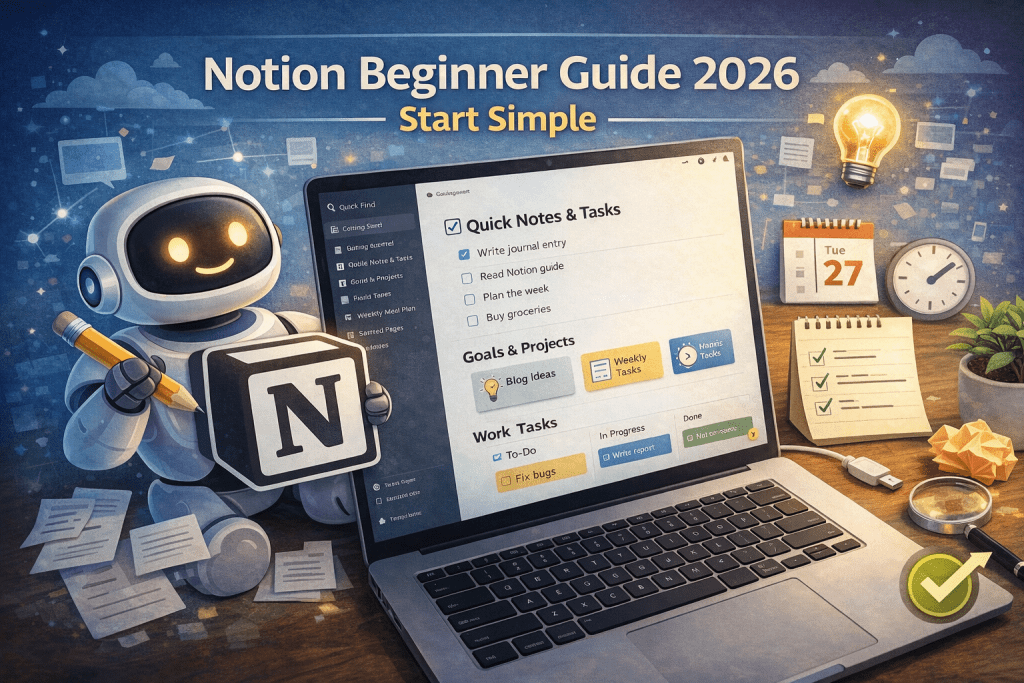
At its core Notion is a tool to organize your stuff. Notes, tasks, ideas, plans. All in one place. You can use Notion for:
- Writing notes in Notion
- Making to-do lists with Notion
- Planning projects using Notion
- Tracking habits with Notion
- Even building systems in Notion
It is like a notebook. Smarter and more flexible. Notion is a tool that can help you with things. I use Notion every day.
Why People Use Notion
There are productivity apps out there so why do people stick with Notion? A few reasons:
- Everything stays together in Notion. You do not have to jump between five apps.
- You can build your setup in Notion. Notion does not force a structure on you. You create your Notion setup.
- Notion works for anything. Students, freelancers, teams or just personal use. Notion is very flexible.
That flexibility can feel overwhelming at first. That is totally normal when you start using Notion. I felt that way too.
The Basics
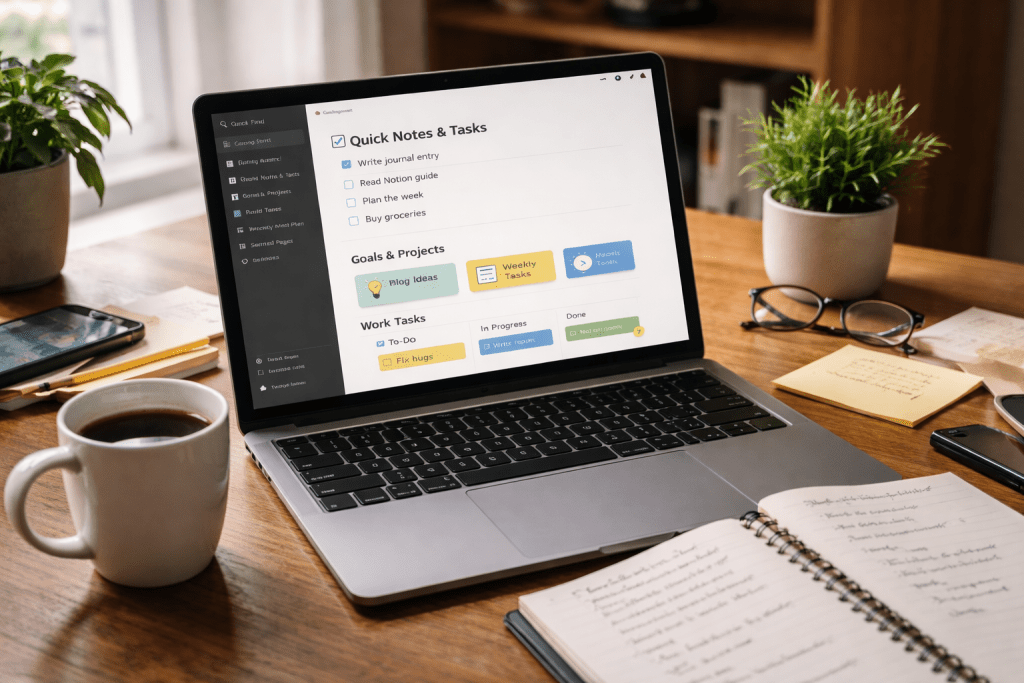
Once you understand these three things Notion starts making sense.
1. Pages in Notion
Everything in Notion is a page. Pages can have pages inside them. So you could have:
- A main dashboard page in Notion
- A page for notes in Notion
- A page for tasks in Notion
It is like folders. More flexible. Notion pages are very useful.
2. Blocks in Notion
This is where things feel a bit different. Every piece of content is a “block.” A paragraph? Block. A checklist? Block. An image? Also a block. You can move Notion blocks around however you want.
3. Databases in Notion
A database is a list. Like:
- A table in Notion
- A task board in Notion
- A calendar in Notion
You will probably use this for things like task tracking or planning content in Notion.
How to Set Up Notion
Let’s keep this simple.
Step 1: Make a Home Page in Notion
Create one page. Call it whatever you like: Home, Dashboard or Workspace. This is where everything starts in Notion.
Step 2: Add a Few Basic Pages in Notion
Inside that home page create links to things like:
- Tasks in Notion
- Notes in Notion
- Projects in Notion
That is enough for now. Seriously. Do not overthink your Notion setup.
Step 3: Use Templates in Notion
Notion has made templates. Use them. They save time. Give you a starting point. You can always tweak things later in Notion.
Step 4: Don’t Try to Be Perfect in Notion
This is where most people mess up. You do not need a system on day one. I tried that. Built this setup…. Then did not use half of it. Keep it simple. Build as you go with Notion.
Practical Ways to Use Notion
You do not need to use every feature in Notion. Just pick what helps.
- Daily Planner: A simple page with tasks and notes for the day. Nothing fancy. Just useful. I use this every day in Notion.
- Habit Tracker: Track habits like reading or exercise. Even a basic table works fine in Notion.
- Content Planning: If you create content Notion is great for ideas, drafts and posting schedule. Keeps everything organized in Notion.
- Study Notes: Perfect for students. You can organize subjects, topics and revision notes in one place in Notion.
- Project Tracking: Even simple projects become easier to manage. You can track tasks, deadlines, progress in Notion.
Small Tips That Actually Help
These are things I wish I knew earlier.
- Type “/” for commands in Notion. This opens up everything quickly.
- Don’t make it look perfect. Function matters more than design in Notion.
- Learn slowly. You do not need to understand everything at once about Notion.
- Reuse templates in Notion. If something works copy it.
- Use it a little every day. Even 5-10 minutes helps you get comfortable with Notion.
Mistakes Most Beginners Make
Honestly almost everyone does these at first.
- Trying to build a system in Notion
- Watching tutorials of using the Notion app
- Making things too complex, in Notion
- Not using Notion consistently
The one? Overthinking. Do not overthink your Notion setup.
Is Notion Actually Worth Using?
Yeah. Only if you keep it practical. Notion will not magically fix your productivity. It is a tool. If you use Notion regularly it can really help you stay organized. Notion is a tool to have. I think Notion is worth using.